
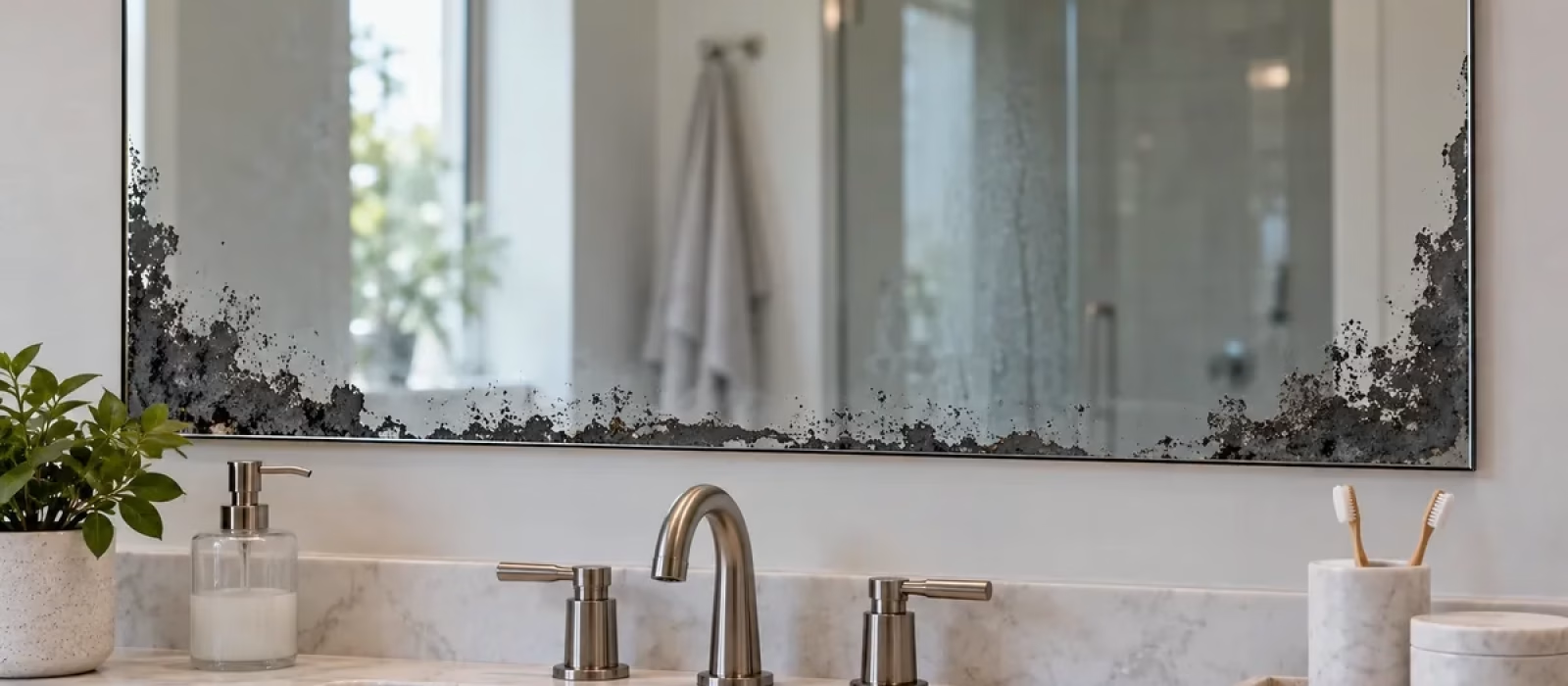
Mirror desilvering is the reason a bathroom mirror develops dark edges, grey clouds or black spots that no amount of cleaning will remove. It starts slowly, usually at a bottom corner, and then creeps inward until the mirror looks old even if the rest of the bathroom is new.
The good news is that mirror desilvering has predictable causes, and most of them can be avoided when a replacement mirror is chosen and installed properly. This guide explains what is happening behind the glass, whether a damaged mirror can be saved, and how to keep a new one clear for years. If you are already planning a replacement, Zenith’s custom mirror service covers made-to-measure mirrors for bathrooms and other rooms.
What Mirror Desilvering Actually Is
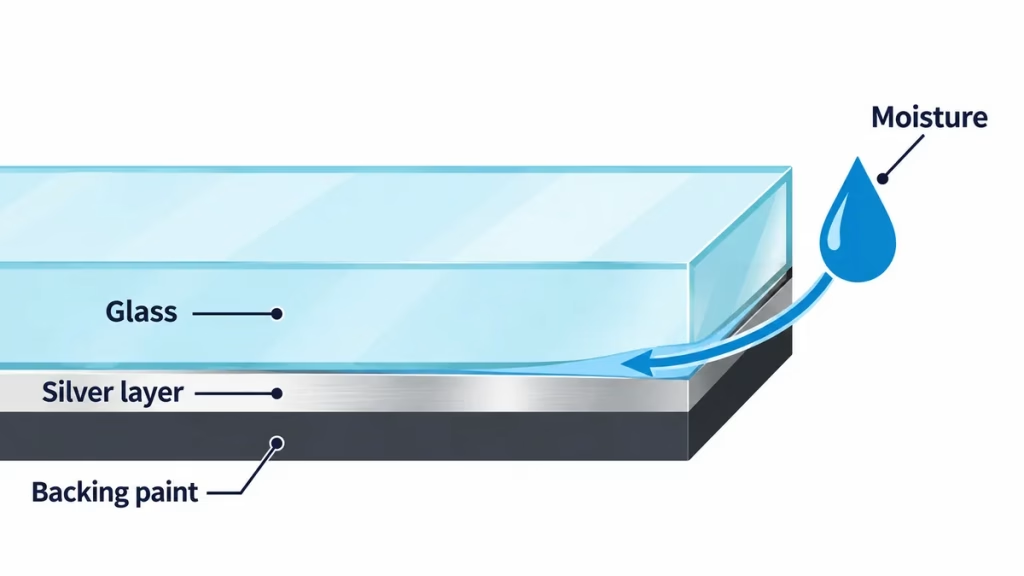
A standard mirror is a sheet of clear glass with a thin reflective silver layer on the back, covered by protective backing paint. The silver creates the reflection, and the paint protects the silver from air, moisture and chemicals.
Mirror desilvering happens when that protection breaks down and the silver layer corrodes. As the National Glass Association explains in its update on mirror installation guidance, the silver film remains vulnerable to deterioration if it is exposed to chemicals or excessive moisture, even though it is protected by paint.
Once the silver corrodes, it can no longer reflect light. That is why damaged areas look black, grey or brown from the front, and why they cannot be wiped away.
What do black edges on a mirror mean?
Black edges on a mirror almost always mean mirror desilvering has started at the exposed edge. The edge is the weakest point because the silver layer is visible there, and it is where cleaning liquid and water tend to collect.
The glass industry often calls this “black edge.” It usually begins along the bottom edge, near the sink or vanity, where splashes and spray land most often.
7 Common Causes of Mirror Desilvering
Mirror desilvering rarely has a single cause. In most homes, it is a combination of moisture, chemicals and installation details that let both reach the backing.
1. Spraying cleaner directly on the glass
Cleaning habits are behind a lot of mirror desilvering. When cleaner is sprayed straight onto a mirror, it runs down and soaks into the bottom edge. Many household glass cleaners contain ammonia or vinegar, which can attack the edge and backing over time. Spray the cloth instead, then wipe.
2. Bathroom humidity and poor ventilation
Hot showers fill a bathroom with moisture that settles on every cool surface, including the edges and back of the mirror. Health Canada’s guide to addressing moisture and mould in your home recommends running an exhaust fan during showers and for at least 30 minutes afterward, and keeping indoor relative humidity between 30% and 50%.
3. Splashes that are never dried
Water from the tap, toothbrushes and hand washing lands on the lower edge of a vanity mirror many times a day. If the edge stays wet, moisture has time to work its way behind the backing paint, and mirror desilvering follows.
4. Mirrors installed tight to the countertop or backsplash
A mirror that sits directly on a countertop or backsplash traps water along its bottom edge. Industry installation guidance recommends leaving a small gap so moisture can drain and dry rather than wick behind the glass.
5. The wrong adhesive
Construction adhesives and caulks that are not made for mirrors can react with the backing paint. The damage often shows up later as dark spots in the middle of the mirror, matching the pattern of the adhesive behind it.
6. No air space behind the mirror
Mirrors mounted flat against a cold exterior wall can collect condensation behind the glass. Mechanical mounting, such as clips or J-channels, and a little breathing room behind the mirror let moisture dry out.
7. Damaged backing paint or edges
Scratches in the backing from handling, rough edges and chips all expose the silver. A clean, properly finished edge gives moisture fewer places to start.
Mirror Desilvering vs Other Mirror Problems
Not every cloudy mirror is a desilvered mirror. Before replacing anything, check which problem you actually have.
| What you see | Likely cause | Can it be cleaned? |
|---|---|---|
| Black or grey edges that grow inward | Mirror desilvering at the edge | No |
| Dark spots or blotches in the middle | Backing damage, often from adhesive or moisture | No |
| White, chalky spots on the front surface | Hard water mineral deposits | Usually yes |
| Streaks or haze that move when wiped | Cleaner residue | Yes |
| Fine lines visible from the front | Surface scratches | No |
A simple test: if the mark is on the front surface, a fingernail or cloth will interact with it. If it sits behind the glass and looks the same from every angle, it is in the silver layer. For mineral spots, our guide to removing hard water stains from glass explains safe methods.
Can Mirror Desilvering Be Repaired?
In practical terms, no. Once the silver has corroded, the reflective layer is gone in that area. Sprays, paints and “mirror repair” kits can hide a small spot from a distance, but they will not restore a true reflection.
Can you fix black spots on a mirror?
You cannot reverse black spots caused by mirror desilvering, but you can sometimes hide or remove them. If the damage is limited to the edges, these options may work:
- Add a frame or decorative border that covers the damaged band
- Have the mirror cut down to remove the damaged edge, if the new size still suits the space
- Replace the mirror and fix the installation details that caused the damage
Antique mirrors are a different case. Specialist resilvering exists for valuable or historic pieces, but for a standard bathroom or wall mirror, replacement is usually faster and more cost-effective.
How to Prevent Mirror Desilvering on a New Mirror
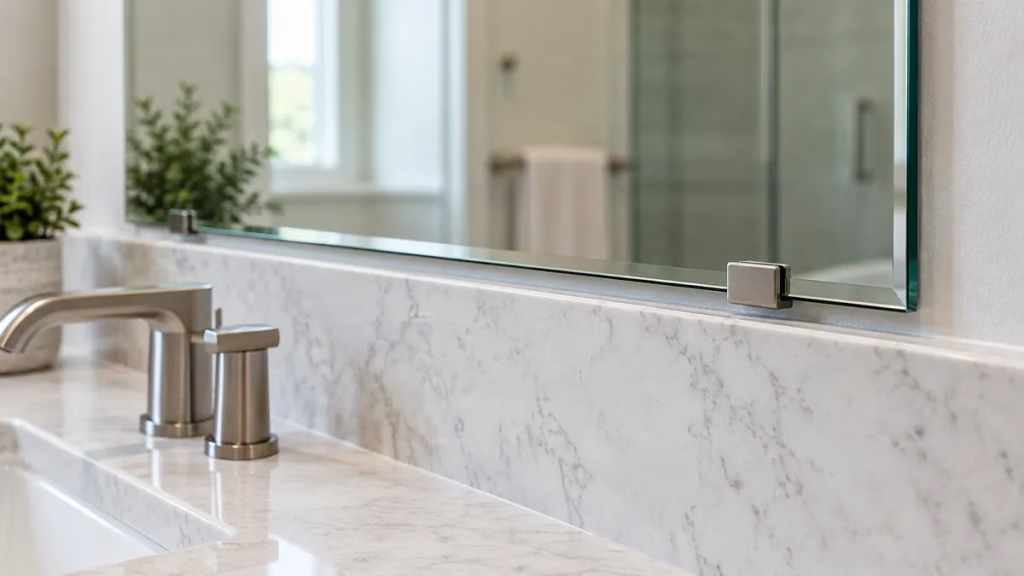
A replacement mirror can last for many years when the cause of the original damage is fixed. Preventing mirror desilvering comes down to keeping moisture and harsh chemicals away from the edges and backing. Focus on these habits and installation details:
- Clean gently. Use warm water and a soft, lint-free cloth for routine cleaning, and dry the mirror right away.
- Keep liquid off the edges. Apply any cleaner to the cloth, never directly to the glass, and dry the bottom edge after use.
- Run the exhaust fan. Ventilation protects the mirror, the paint and the drywall at the same time.
- Leave a gap at the bottom. Ask the installer not to set the mirror tight to the counter or backsplash.
- Use mirror-safe mounting. Clips, channels or a mirror-compatible adhesive protect the backing.
- Choose a finished edge. Polished or bevelled edges look cleaner and are easier to keep dry. Our guide to glass edge types compares the options.
Quality matters too. Mirror coatings and backing paints have improved over the years, so ask about a moisture-resistant mirror for bathrooms, especially in a busy family bathroom or a basement with higher humidity.
Does mirror desilvering keep spreading?
Usually, yes. Mirror desilvering tends to grow slowly inward from the edge as long as moisture and cleaning chemicals keep reaching the damaged area. Fixing the ventilation and cleaning habits can slow it down, but the areas that are already dark will not recover.
That is why it pays to act while the damage is still a thin band. A narrow strip can sometimes be hidden by a frame or trimmed off, while damage that has spread several centimetres into the glass usually means replacement.
Choosing a Replacement Mirror for a Humid Bathroom
If you are replacing a mirror lost to mirror desilvering, use the opportunity to choose one that suits the room. A few decisions make a big difference:
- Size and clearance. Size the mirror so it clears the backsplash, faucet and any light fixtures, leaving room for air and drainage at the bottom.
- Edge finish. A polished or bevelled edge is smoother and easier to keep dry than a rough cut edge.
- Mounting method. Discuss clips, channels or a mirror-safe adhesive based on the wall and the mirror’s size.
- Shape and style. Made-to-measure mirrors can fit awkward walls and alcoves; our custom mirror ideas show what is possible.
- Location. Mirrors on cold exterior walls or right beside the shower need extra attention to ventilation.
A professional installer will also check the wall itself. Freshly painted or damp walls can trap moisture behind a new mirror, so the surface should be dry and sound before the glass goes up.
Why Mirror Desilvering Often Shows Up in Fall and Winter
When the weather turns cold across Toronto and the GTA, windows stay closed and showers get longer and hotter. Moisture that used to escape through an open window now stays in the bathroom unless the fan is doing its job.
Mirrors on exterior walls also get colder in winter, so warm, humid air condenses more readily on and behind them. If you have noticed new dark edges this time of year, check the fan and the mirror’s mounting before choosing a replacement. A glass maintenance routine also helps; our glass maintenance checklist includes mirrors alongside windows and shower doors.
Fall is also a practical time to replace a damaged mirror before holiday guests arrive. A new, properly installed mirror is one of the quickest ways to refresh a bathroom without a full renovation.
Replace a Desilvered Mirror With Zenith Glass
If mirror desilvering has spread beyond what a frame can hide, Zenith Glass & Mirror can measure, cut and install a new mirror for your bathroom, hallway or gym wall. We serve homes and businesses across Toronto and the GTA, and we pay attention to the details that prevent black edges from coming back: edge finish, mounting method and clearance at the bottom.
Planning something bigger? Browse our mirrored glass walls for full-wall installations, then request a free quote with a few photos of your current mirror and the space.