

Storefront glass shows off the business, brings in daylight, keeps out the weather, and it’s the first thing a burglar tests. Whether you’re planning a new glass storefront, replacing an old one or dealing with a broken pane, the decisions come down to the framing system, the glass, the entrance door and the rules for glass people can walk into.
This guide covers each of those for Ontario businesses, plus winter performance, what happens after a break-in and what drives the price. If you already have a project in mind, see Zenith’s commercial storefront glass services.
Storefront Systems: Framed Aluminum vs Frameless Glass
In the glazing trade, a “storefront” usually means an aluminum framing system made for shops, restaurants, offices and other ground-floor commercial spaces. The frame holds large glass panels and one or more entrance doors.
Framed aluminum storefronts
Most retail storefront glass systems are framed. Aluminum mullions and rails are cut to size and assembled on site, which is why they’re called stick-built systems, and the glass is set in with gaskets or glazing tape and sealant. A framed glass storefront is practical: one pane can be replaced without disturbing the rest, the frame finish can match your branding, and standard doors and hardware fit easily.
Frameless and structural glass
Frameless storefronts cut the visible metal down to slim channels, clamps or patch fittings, so the front reads as one sheet of glass. They suit boutiques and showrooms, with the trade-off of heavier made-to-measure glass and longer waits when a panel breaks. Structural glass walls that rely on glass fins or structural silicone are engineered systems that need a designer from the start.
Thermally broken frames
Aluminum conducts heat well. A thermally broken frame has an insulating strip between the inside and outside halves of each aluminum section, so the room side stays warmer in winter. For a heated store in Ontario, that means less frost on the frames and a more comfortable area by the door. Frames without a thermal break are still common for interior mall storefronts.
6 Types of Storefront Glass
A single storefront opening often combines several kinds of glass, such as an insulated unit with a Low-E coating and a laminated pane. These are the six you’ll hear about most.
| Glass type | What it is | Where it fits | Keep in mind |
|---|---|---|---|
| Tempered | Heat-treated glass that’s stronger than ordinary glass and breaks into small, blunt pieces | Entrance doors, sidelights and panes near the floor | Can’t be cut after tempering, so replacements are made to order |
| Laminated | Glass layers bonded to a plastic interlayer that holds the pieces in place when it breaks | Display windows and stores with break-in risk | Slows a smash-and-grab, but it isn’t unbreakable |
| Insulated glass unit (IGU) | Two or more panes sealed around a spacer with air or gas between them | Exterior storefronts on heated stores | A failed seal shows up as fog between the panes |
| Low-E coated | Glass with a microscopically thin coating that reflects heat | Heated stores and sunny south- or west-facing fronts | Usually placed inside an insulated unit |
| Tinted or reflective | Tinted or coated glass that cuts glare and solar heat | Sunny exposures and offices that want privacy | Makes products harder to see from the street |
| Spandrel | Opaque, usually coloured glass | Bands above doors that hide floor slabs, ceilings or structure | Not see-through; match the colour with a sample |
Tempered and laminated aren’t an either-or choice. Laminated glass can be made with tempered layers, and an insulated unit can include a laminated pane for security and insulation in one opening. Our guide to tempered vs laminated glass compares the two in detail.
Glass Entrance Doors, Hardware and Accessible Entrances
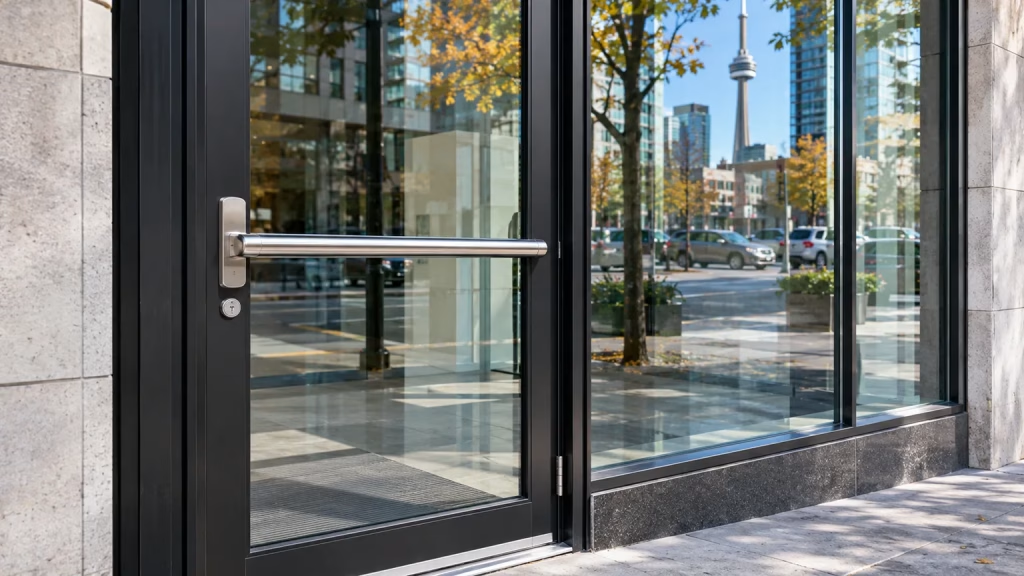
Doors in an aluminum storefront have aluminum stiles around the glass and swing on hinges or pivots, with a closer to bring them back. All-glass doors hang on patch fittings with a pivot or floor closer. Hardware includes pull handles, push bars, panic devices where the exit calls for them, and locks. A slamming closer or dragging pivot can usually be fixed without touching the glass.
For a new storefront or an extensive renovation, the entrance also has to meet barrier-free rules. Ontario’s page on accessibility in the Building Code explains that the 2024 Building Code covers building entrances, doorway widths and power door operators, and that existing buildings aren’t affected unless an extensive renovation is planned. Article 3.8.3.3 of the Code sets a clear width of at least 850 mm for doorways on a barrier-free path of travel and requires power door operators on the doors of a barrier-free entrance.
Safety Glazing Rules for Storefront Glass in Ontario
Ontario’s 2024 Building Code is the 2020 National Building Code plus Ontario’s amendments, published online as the 2024 Building Code Compendium. For buildings designed under Part 3 of the Code, Article 3.3.1.20 is clear about glass doors:
- Glass doors must be safety glazing. That means laminated or tempered glass conforming to CAN/CGSB-12.1, “Safety Glazing”, or wired safety glass.
- People must be able to see the door. Glass doors need visually contrasting hardware, bars or other permanent fixtures.
- Fully glazed doors and wide panels need a marking strip. This covers fully glazed doors, plus fully glazed sidelights and panels wider than 300 mm. The strip must be continuous, opaque, contrasting and at least 50 mm wide, set 1,350 mm to 1,500 mm above the floor. A logo can be part of it if the strip stays opaque and continuous.
Smaller buildings designed under Part 9 follow Article 9.6.1.4, which requires safety glazing or wired glass in public-area sidelights wider than 500 mm that could be mistaken for doors, and in larger glass areas of public entrance doors.
CAN/CGSB-12.1 is the national safety glazing standard. Its scope says it aims to reduce cutting and piercing injuries when glass in human impact areas breaks, and that it doesn’t address strength or installation. So safety glazing controls how glass breaks, not how thick it must be; pane thickness depends on size and wind exposure and should come from your supplier or designer.
Winter, Energy and Condensation at the Frames
A large glass front loses heat through the glass, the frame and around the door, and Ontario winters expose every weak spot.
- Glass. Insulated glass units are the norm for heated stores, and a Low-E coating with argon fill improves them further.
- Glass edges. Natural Resources Canada’s Keeping the Heat In guide notes that traditional aluminum-box spacers add heat loss and condensation along the glass edges, and that better insulating spacers reduce it. Ask about warm-edge spacers.
- Frames. Thermally broken framing keeps the inside of the aluminum warmer and less likely to frost.
- Door and drainage. Check door sweeps, weatherstripping and the threshold before the cold arrives, and keep the frame’s weep holes clear so water can drain instead of freezing.
A little frost at the bottom of the glass on the coldest days is common, especially near the door. Water running down the frames every morning, ice on the inside of the frame or fog between the panes points to a bigger problem: a frame without a thermal break, a failed seal or air leaking around the door.
Break-Ins and Emergency Storefront Glass Replacement
A smashed storefront is a safety and security problem first and a glass problem second. Our emergency glass repair guide covers the first steps in detail. In short:
- Keep people back. Call 911 if a crime is in progress or someone is hurt, and don’t go inside if someone may still be there.
- Leave the scene for police. Don’t sweep up or touch the frame until police have finished, then photograph the damage for your insurer.
- Secure the opening. A glass company removes loose glass and boards up or covers the opening.
- Measure and order. Tempered glass can’t be cut once it’s tempered, and insulated units are built to size, so most storefront panes are made to order.
- Install and check. The permanent glass goes in, and the door hardware and seals are checked.
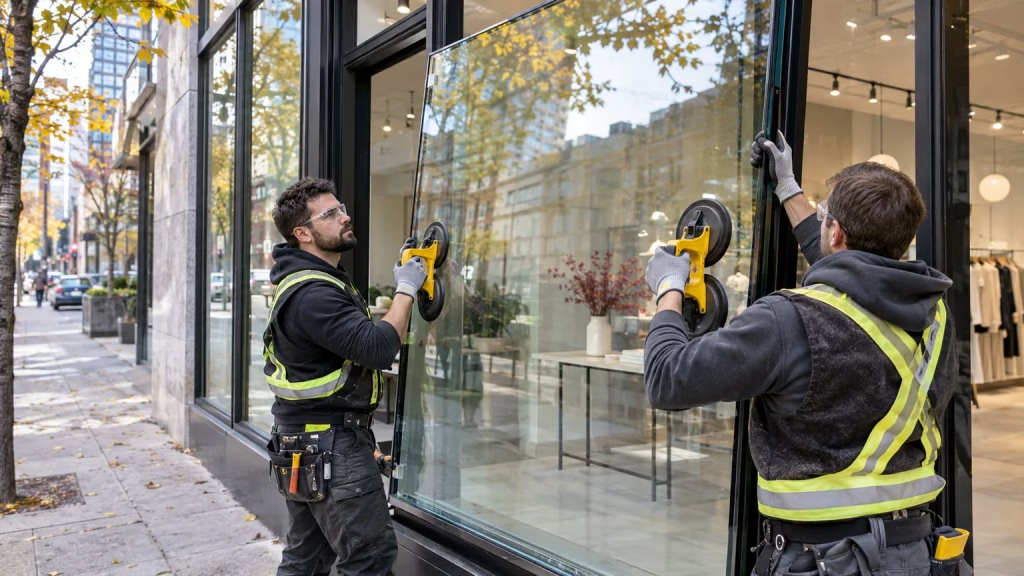
That’s why storefront glass replacement often takes two visits: one to secure the opening and one to install the permanent glass. If break-ins are a concern, it’s the right moment to switch to laminated glass, which holds together after impact and slows down a smash-and-grab.
What Storefront Glass Costs Depend On
A reliable quote starts with measurements and photos, not a price per square foot over the phone. These factors move the number most:
- Size and glass make-up. Large panes need thicker glass and more lifting equipment, and laminated, insulated, Low-E or tinted glass each add cost.
- Frame condition. Replacing glass in a sound frame usually costs less than new framing. Frameless systems use heavier glass and specialty fittings.
- Doors and hardware. Closers, pivots, panic hardware and power operators are priced separately from the glass.
- Access. Upper panes, busy sidewalks, limited parking and the need for a lift all affect labour time.
- Timing. After-hours and emergency calls, and a board-up visit before the permanent glass, add to the total.
When you compare quotes, ask each contractor to spell out the glass thickness and whether it’s tempered, laminated or insulated, so you’re comparing the same product.
Maintenance, Common Mistakes and Choosing a Contractor
Maintenance. Clean the glass with a non-abrasive cleaner and a soft squeegee, and skip scrapers that can scratch glass or damage coatings. Check closers, pivots and locks regularly, and look for chipped edges, cracked sealant, loose gaskets, fog between panes and water inside the frame. Our commercial glass maintenance checklist has a fuller list.
Common mistakes to avoid:
- Replacing broken door or sidelight glass with ordinary glass because it’s in stock.
- Choosing glass on price alone for a store that has had break-ins.
- Skipping thermally broken framing or insulated glass on a heated storefront.
- Ignoring a slamming closer or dragging door, which wears the frame and stresses the glass.
- Not asking whether a renovation triggers barrier-free requirements or needs a building permit.
Choosing a contractor. Look for commercial storefront experience and ask how they handle emergencies. Get a written quote that lists the glass type, thickness, framing and hardware, ask for proof of liability insurance and WSIB coverage, and check the workmanship warranty.
Storefront Glass Installation and Repair With Zenith Glass
Zenith Glass & Mirror installs, replaces and repairs commercial storefront glass for retail stores, restaurants, offices and other businesses from our North York shop at 59 Milvan Drive. Through our commercial glass repair service, we also repair and replace glass doors, match the style, thickness and tint of existing glass, and provide emergency service to secure your business. We work with businesses across Toronto and the GTA.
Send photos of your storefront, the rough size of each pane and what you’d like to change, then request a free quote.